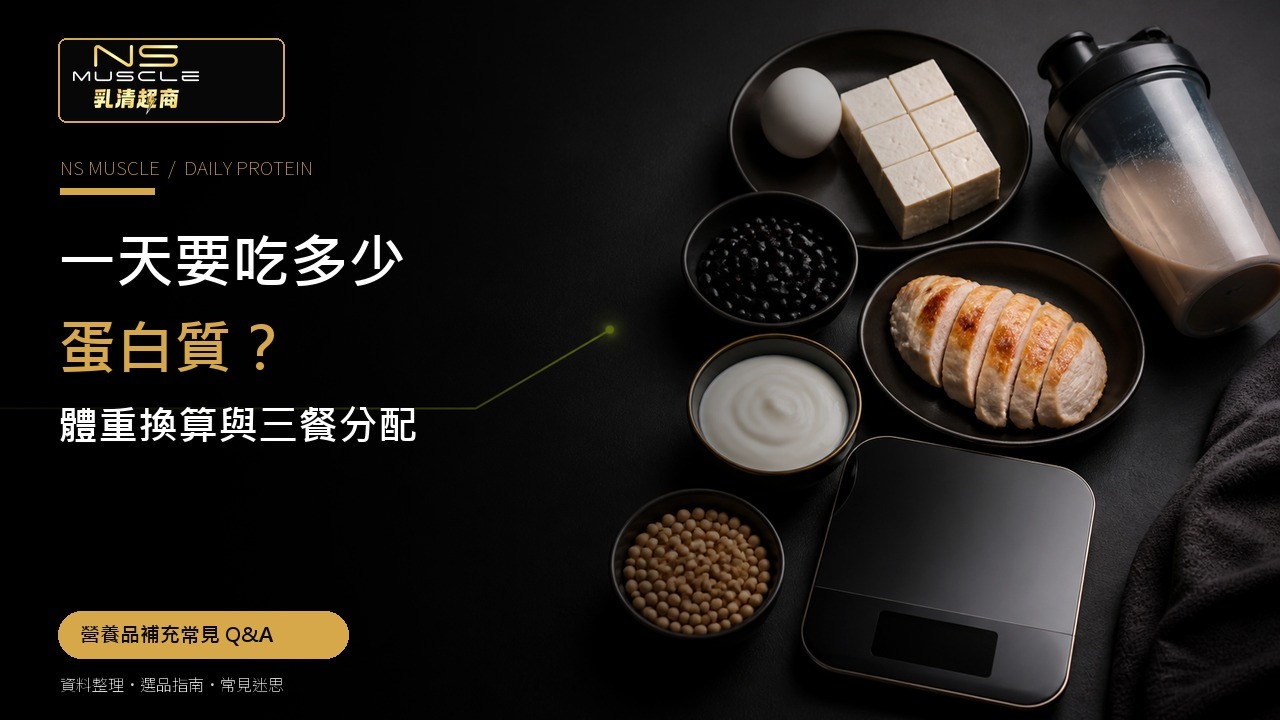
Quick answer: More protein is not automatically better, and protein is not only for people who lift weights. For generally healthy adults, Taiwan's Dietary Reference Intakes use 1.1 grams per kilogram of body weight per day (g/kg/day) as a starting reference. People doing regular resistance or endurance training commonly use a range of about 1.4–2.0 g/kg/day. Your best target still depends on total energy intake, training load, eating pattern, age, goals, and health status.
30-second summary
- Estimate your daily starting point with body weight × a suitable g/kg target.
- Spread protein across three to four meals instead of forcing most of it into one shake.
- Start with protein-rich foods; use whey or plant protein powder to fill a practical gap.
- Daily intake and long-term consistency usually matter more than hitting a tiny post-workout window.
How to estimate your daily protein intake
Choose a starting range that fits your situation, then multiply it by your body weight in kilograms. These figures are general reference points—not personalized prescriptions.
| Situation | Daily starting point | How to interpret it |
|---|---|---|
| Generally healthy adults | 1.1 g/kg/day | The adult reference value in Taiwan's eighth-edition Dietary Reference Intakes. |
| Adults aged 71 and older | 1.2 g/kg/day | The reference value listed for this age group in the same Taiwan guidance. |
| Regular exercise or muscle-building training | 1.4–2.0 g/kg/day | A commonly cited sports-nutrition range for exercising individuals; the appropriate point within it depends on training, energy intake, and goals. |
Note: These numbers are general estimating tools. If you have kidney, liver, or metabolic disease—or another condition that affects nutrition—ask a physician or registered dietitian for individualized advice.
Weight-based protein examples
| Body weight | General reference 1.1 g/kg/day | Regular training 1.4–2.0 g/kg/day |
|---|---|---|
| 50 kg | 55 g/day | 70–100 g/day |
| 60 kg | 66 g/day | 84–120 g/day |
| 75 kg | 83 g/day | 105–150 g/day |
For example, a 60 kg person who strength trains three or four times per week might begin near 60 × 1.4 = 84 grams per day. That does not mean they must immediately aim for the top of the range. Start with a realistic intake, then consider recovery, training, appetite, and how well the plan fits everyday meals.
How to spread protein across meals
If your daily target is 90 grams, one practical pattern could be 20–25 grams at breakfast, 25–30 grams at lunch, 25–30 grams at dinner, and another 10–20 grams from a snack. Sports-nutrition literature often uses about 0.25 g/kg per meal, or roughly 20–40 grams of high-quality protein per meal, as a practical reference. Body size, age, food choices, and the rest of the meal still matter.
- Breakfast: Add eggs, unsweetened soy milk, milk, or yogurt when breakfast would otherwise be only toast and coffee.
- Lunch and dinner: Include a palm-sized portion of meat, fish, eggs, tofu, or another soy food as a simple visual starting point.
- After training or on busy days: If a regular meal is not practical, whey or plant protein can help cover the remaining gap.
How much protein is in common foods?
Use these figures only for quick planning. Brand, cut, water content, serving size, and cooking method can change the total. For packaged foods, check the nutrition label.
- 2 eggs: about 12–14 g
- 240 mL milk: about 8 g
- 100 g traditional tofu: about 8–12 g
- 100 g cooked chicken breast: about 25–30 g
- 1 serving of protein powder: commonly about 20–25 g, depending on the product label
Do you need protein powder?
Not necessarily. If regular meals consistently cover your target, protein powder is optional. Its main advantage is convenience and predictable serving size. It can be useful when breakfast is low in protein, a full meal is not available after training, or eating out makes the daily total difficult to reach.
When comparing products, look at protein per serving, sugar and fat, allergens, and the full ingredient list. A large scoop or the words “high protein” on the front do not tell the whole story.
Frequently asked questions
Q1: Do I need protein within 30 minutes after exercise?
No countdown clock is required. Daily intake and regular distribution usually matter more. If you ate a protein-containing meal within the few hours before training, you can normally follow the workout with your next planned meal.
Q2: Will eating more protein automatically build more muscle?
No. Muscle growth also requires progressive resistance training, sufficient overall energy, sleep, and recovery. Protein beyond what you need cannot replace training.
Q3: Should I aim for a similar protein intake on rest days?
You can keep a similar everyday target because recovery continues beyond the training session. If total energy intake is lower on a rest day, other parts of the diet may change, but there is no need to remove protein for the day.
Q4: Should protein intake be higher during fat loss?
During an energy deficit, especially alongside resistance training, a higher protein intake is often used to support lean-tissue retention and satiety. The appropriate amount still depends on total energy intake, training, health status, and individual tolerance.
Calculate the need before choosing the supplement
Fill the gap you actually have—no more, no less. Compare protein per serving, ingredients, allergens, and flavor before choosing whey or plant protein.
Prepared by: NS MUSCLE | Last updated: September 2, 2026
This article provides general sports-nutrition information and does not replace individualized advice from a physician, registered dietitian, or other qualified healthcare professional.
Related reading
- WPC vs WPI vs WPH: How to Choose a Whey Protein
- Plant Protein vs Whey: Soy, Pea, and Rice Protein Compared
- Can You Take Creatine and Whey Protein Together?


